How to Record Production Sound for Ping Pong Documentary Scenes?
Recently, I’ve been working on a feature-length project that shoots frequently in a ping pong hall. This has given me the opportunity to spend some time thinking about and optimizing our sound recording setup for these documentary-style table tennis scenes.
1. Ambience Recording
There are about 20 tables in the hall, and the low ceiling gives the space a very distinct acoustic character. When the hall is at full capacity, the environment becomes quite noisy. To capture this, I recorded spatial ambience tracks at various capacity levels, which will provide a great panoramic perspective for laying down backgrounds during post-production.
2. Wireless Mic Placement & Plant Mics
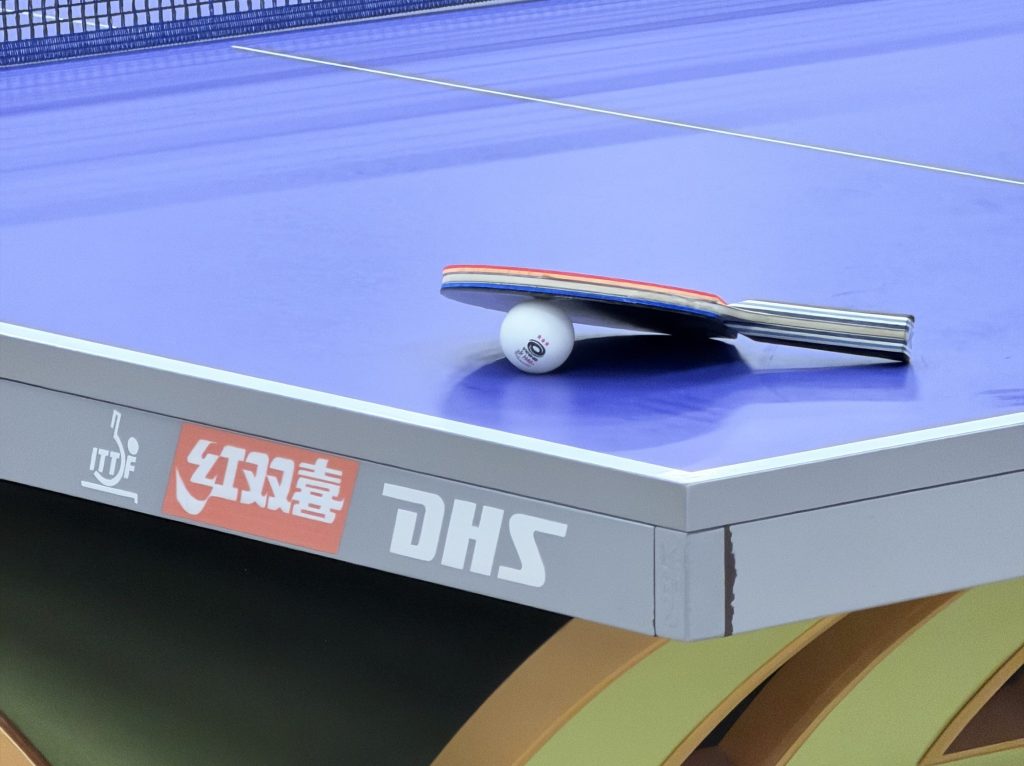
Since the athletes are undergoing intensive training, it isn’t very convenient for them to wear body mics (lavaliers). Fortunately, there isn’t a massive amount of dialogue during active play. After experimenting with a few different approaches, I opted to use plant mics on the tables.
When placing these plant mics, it is crucial to coordinate with the camera positions. I make sure to hide the mics in spots that stay clear of the camera crew’s preferred shooting angles.
3. Athlete Positioning & Mic Alignment
Having never played ping pong before, I spent some time observing their movements during a few practice sessions. I noticed that athletes primarily position themselves on their backhand side, opposite to their racket hand (e.g., right-handed players stand slightly to the left, and left-handed players stand to the right). Based on this, plant mics can be offset toward the side where the players actually stand.
4. Managing High Dynamic Range & Transients
The audio dynamic range on a ping pong court is much wider than one might expect. Specifically, the moments of paddle impact and the ball bouncing on the table create massive transients. To handle this, it is highly recommended to prioritize wireless transmitters with 32-bit float internal recording, or carefully adjust the gain staging on the wireless transmitters ahead of time.
5. Spotting Dialogue Scenarios
When athletes do speak, they usually do so from a few predictable spots: the striking position, the center of the table, or the break area where they grab a drink. You can stake out these locations in advance to stay ahead of the action.
6. Keeping the Boom Pole on Standby
Since the players aren’t mic’d up, dialogue can break out anywhere at any moment. You need to keep the boom pole ready at all times, prepared to push in alongside the camera crew at a moment’s notice.
7. Situational Awareness Around Active Players
Unlike commercial or narrative film sets, these athletes are doing real training, and there are other people moving around the venue simultaneously. It is essential to constantly track the athletes’ range of motion, doing our jobs while actively dodging them to avoid any collisions.
A camera operator’s visual attention is often locked into a very narrow frame. As a sound recordist with a broader view of the surroundings, you can act as a second pair of eyes and remind the camera operator of their safety perimeter.
8. Communication with the Director
If the director wants to conduct on-the-fly, impromptu interviews, try to coordinate ahead of time to pick a quieter spot, or wait for a moment when the training intensity dies down.
