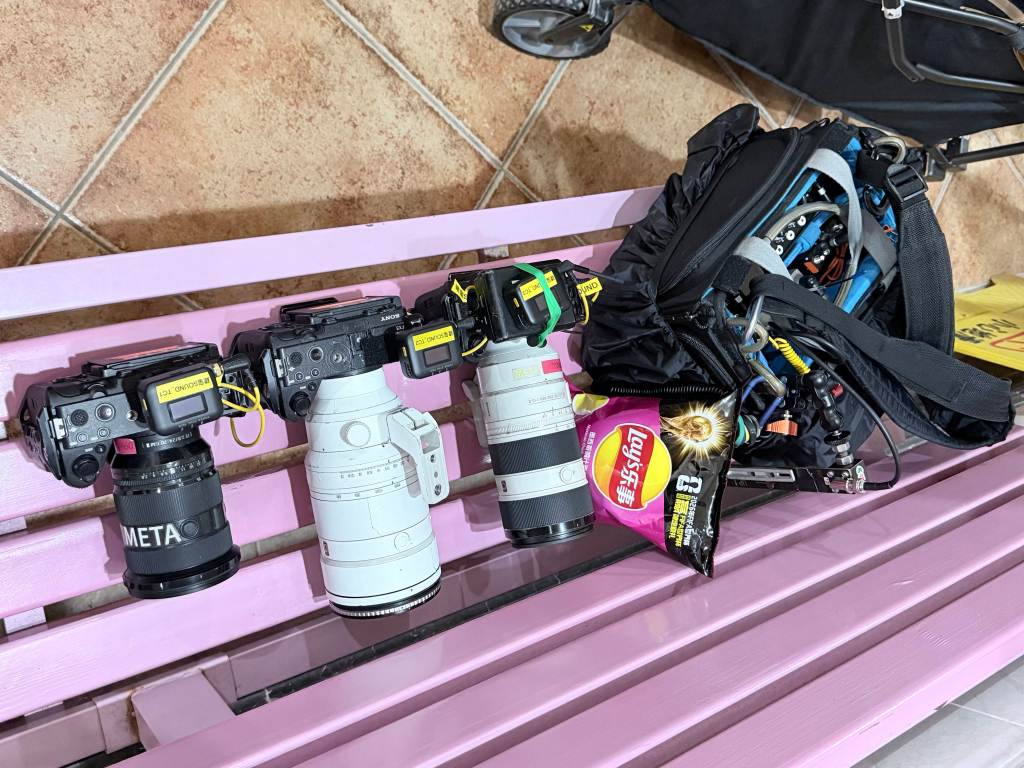
At a recent pre-production meeting, the director and cinematographer emphasized one thing: we weren’t going to stage anything. This would be purely observational.
That brought me back to a question I’ve thought about many times: from a production sound perspective, what is actually different between shooting a documentary and shooting a narrative film?
Over more than ten years working in production sound, I’ve constantly moved between different formats: feature films, commercials, TV series, variety shows, experimental projects, short films, video podcasts, and more. I’ve seen very different ways of working on different sets, and I’ve had to keep adjusting my own approach along the way.
Of all these forms, documentary has always been my favorite—and probably the one that has challenged me the most.
1. The uncertainty of the shooting plan
Open almost any narrative screenplay and you’ll find a fairly clear written blueprint: locations, blocking, actions, dialogue. The crew then goes to set and tries, as faithfully as possible, to turn those words into something real.
Documentaries may also have schedules and plans before the shoot, but once filming begins, far more unpredictable things can happen. That means constant technical and logistical improvisation.
For example, an indoor observational scene may suddenly be interrupted by something happening somewhere else, and you may need to grab all your equipment and follow immediately.
At the same time, if you don’t want to disturb the environment around your subjects, you need to remain as unobtrusive as possible while still maintaining all the technical functions required for recording.
So even when I’m shooting something that seems highly predictable, I always keep a little plan in the back of my mind:
What if we have to leave here immediately?
How quickly can I move?
2. Unpredictable—and unrepeatable—content
On a narrative set, if a take doesn’t work, you can usually do it again. And again.
In documentary work, there is rarely an opportunity to ask someone to repeat an action. Some subjects may explicitly refuse to do so, and even asking can make them uncomfortable or resistant.
That means both the camera and sound departments have to capture moments as they happen.
Narrative dialogue is predetermined 99 percent of the time. As a production sound mixer, I can read the script, look at the lighting and camera positions, understand the actors’ dialogue rhythm, and coordinate boom positions and the boom operator’s movement accordingly.
A documentary has no such script.
A conversation can begin anywhere, at any time. Sometimes important dialogue is happening somewhere the camera isn’t even looking.
One of the most famous examples is the documentary series The Jinx—a film I’d love to talk about separately sometime.
I once invited a sound mixer who normally works exclusively on narrative productions to join a documentary shoot, doubling as an observational camera operator.
At the end of the day, he said to me:
“It really does feel quite different.”
The tools may look similar, but when the context changes, the entire working method changes with it.
3. Actors vs. real people
Most documentary subjects are ordinary people who have little or no experience being filmed.
Unlike actors on a narrative production, they are not employees of the production. The relationship is closer to an interaction between people on relatively equal terms.
Personally, I don’t think documentary subjects should be excessively directed.
Instead, the crew needs to adapt to their emotions, routines, pace, and daily life.
If a subject is upset, or if a situation has entered a particularly sensitive stage, sound recording should not become something that unnecessarily interferes with or interrupts what is happening.
Allowing a camera into your life and opening yourself up to strangers takes courage.
I think the crew should offer subjects encouragement and support rather than treating them merely as objects of observation from some omniscient point of view.
I also know cinematographers and sound recordists who prefer a much more intrusive approach. Everyone develops their own methodology.
Mine is probably on the more sensitive side.
I’m constantly adjusting both the psychological and physical distance between myself and the person being filmed.
4. Sound department vs. working solo
A traditional narrative sound department is rarely a one-person operation. It normally consists of a production sound mixer and one or more assistants or boom operators.
In documentary production today, however, it is increasingly common for a single sound recordist to handle the entire production sound workflow alone.
The camera department may have several cameras covering the scene, as well as assistants helping carry and manage equipment.
Meanwhile, the sound recordist is often doing the jobs of mixer, assistant, wireless technician, and equipment manager simultaneously.
That places much greater demands on both physical endurance and experience.
On many documentary interview programs today, for example, the camera department may consist of three or four camera operators and one or two assistants.
When traveling, some camera operators arrive carrying little more than a backpack.
The sound recordist arrives with bags everywhere.
More wireless microphones.
IFB feeds for directors and producers.
An endless cycle of batteries.
From the outside, the sound recordist may appear to be standing still with headphones on.
But if you could switch into the sound recordist’s point of view, I often feel like an octopus.
And my brain never really stops running.
5. Standardized workflows vs. endless possibilities
When I first started working on narrative productions, the range of available equipment was much narrower.
Most productions followed relatively standardized workflows. Things you learned in film school could still be directly applicable several years later.
Today, cameras, recorders, and wireless systems have exploded in both variety and functionality.
Professional production tools have also become increasingly accessible to everyday creators, and many traditional workflows have been broken apart.
Every so often, I encounter another new piece of equipment on a shoot, and I have to learn its technical details and workflow all over again.
Narrative productions often have enough personnel and resources to use larger, more expensive systems for recording both image and sound.
Documentary production has to place much greater emphasis on cost, portability, and speed.
Many independent filmmakers begin with limited budgets, and sometimes they are not even familiar with professional filmmaking equipment.
That can make designing a production sound plan surprisingly difficult.
When this happens, I try to step outside the perspective of “the sound person.”
Instead, I think like a filmmaker:
Given the resources this person actually has, what is the best possible plan I can help them build?
6. Greater dependence on production sound
Narrative dialogue can go through dialogue editing and ADR.
Documentaries are usually far more dependent on the original production recordings.
As a result, a seemingly ordinary piece of location sound may eventually become the most important sound in an entire scene.
Whenever I imagine the film reaching post-production, I think about what happens if a sentence I failed to record properly turns out to be critically important.
I picture the sound editor repeatedly struggling with that piece of audio.
That thought constantly pushes me to take every recording seriously.
7. Different priorities in sound reports
Narrative productions have scenes, setups, shot numbers, and takes. The logic for locating material in post is very clear.
Documentary footage may consist of hours of continuous observation.
In that situation, file naming, character notes, and event descriptions can become much more important.
When I’m working alone on set, it can be difficult to keep up with everything, but I still try to use my phone to note important moments and time references whenever I get the chance.
After I return home—or once the whole shoot is finished—I organize those notes more carefully.
Part of that is for my own archive.
Part of it is for the director, so that important material can be located quickly during post-production.
It’s a habit I’ve gradually developed over the years.
8. A different approach to power
Narrative productions can rely on a more complete infrastructure: equipment vehicles, power distribution, assistants, and dedicated support systems.
Documentary work often requires moving all day.
That means battery capacity, charging strategy, equipment weight, and power management directly affect how effectively you can work.
And these are only some of the differences.
There are many more.
Most of what I know has accumulated slowly through practice.
It may sound exhausting—and sometimes it is.
But I still love this job, and I’m deeply grateful that I get to do it.
With a pair of headphones and a microphone, I’ve traveled to many places, met many fascinating people, and listened to many fascinating conversations.
